
© sisap challenge committee.
© sisap challenge committee.
| Team | Members | Task | Paper | Repo |
|---|---|---|---|---|
| BrownCICESE | Foster, Magdaleno-Gatica, Kimia | 1, 2 | Refinement-Based Graph Construction for Search in Low-Memory Systems | https://github.com/sisap-challenges/sisap25-BrownCICESE |
| cm-lll | Lou, Ma, Luo, Ruan, Wu, Lu, Mao | 1 | Memory-Constrained DiskANN | https://github.com/sisap-challenges/sisap25-cm-lll |
| Crusty Coders | Dearle, Connor, Claydon, McKeogh | 1, 2 | Fast, Compact NN-Table Build Using Equi-Voronoi Polytopes | https://github.com/sisap-challenges/sisap25-metric_space_rust |
| DCC-UChile | Bustos, Chen | 2 | SISAP Indexing Challenge 2025 – Solution for Task 2 Using Root Join | https://github.com/sisap-challenges/sisap25-DCC-Uchile |
| hforest | Imamura | 1, 2 | — | https://github.com/sisap-challenges/sisap25-hforest |
| JLapeyra | Lapeyra | 1, 2 | — | https://github.com/sisap-challenges/sisap25-Lapeyra |
| TeamDoubleFiltering | Higuchi, Imamura, Shinohara, Hiratta, Kuboyama | 1 | Double Filtering Using Short and Long Quantized Projections | https://github.com/sisap-challenges/sisap25-TeamDoubleFiltering |
Four teams participated in both tasks, two teams focused solely on Task 1, and one team addressed only Task 2. Two baselines were provided: BL-SearchGraph (a graph-based index using SimilaritySearch.jl) and BL-Bruteforce (parallel exhaustive scan), both using PCA projection and 8-bit scalar quantization.
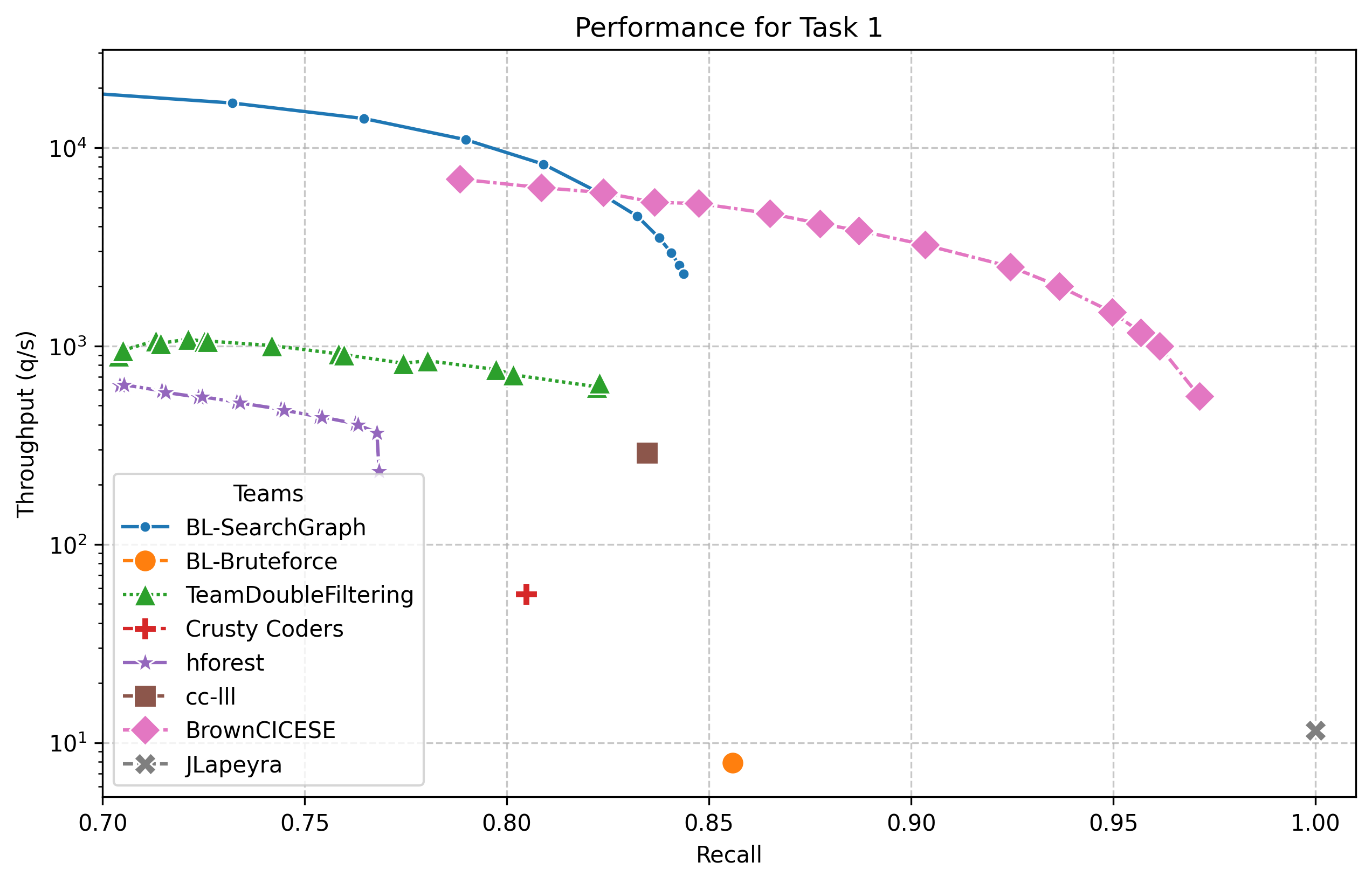
Task 1 required memory-efficient approximate nearest neighbor search on the PUBMED23 dataset (23.9 million 384-dimensional vectors, 35 GB on disk). Solutions operated under 16 GB RAM, 8 virtual CPUs, and a 12-hour wall-clock limit. The ranking criterion was the highest search throughput (queries/second) among configurations achieving at least 0.7 average recall for nearest neighbors using out-of-distribution queries.
| Team | Rank | Recall | Build time (s) | Query time (s) | Throughput (q/s) | Container time (s) | Median rmem (GB) | Max rmem (GB) |
|---|---|---|---|---|---|---|---|---|
| BL-SearchGraph | 1 | 0.7322 | 4,320 | 0.60 | 16,769 | 4,667 | 9.6 | 13.2 |
| BrownCICESE | 2 | 0.7884 | 9,563 | 1.44 | 6,928 | 9,646 | 14.2 | 14.3 |
| TeamDoubleFiltering | 3 | 0.7212 | — | 9.25 | 1,081 | 324 | 9.6 | 9.6 |
| hforest | 4 | 0.7053 | 2,243 | 15.70 | 637 | 2,594 | 12.2 | 16.0 |
| cm-lll | 5 | 0.8347 | 6,419 | 34.61 | 289 | 6,457 | 11.6 | 11.6 |
| Crusty Coders | 6 | 0.8048 | 2,980 | 178.00 | 56 | 3,161 | 14.5 | 14.5 |
| JLapeyra | 7 | 1.0000 | — | 870.32 | 11 | 873 | 7.9 | 15.3 |
| BL-Bruteforce | 8 | 0.8559 | 0 | 1,265.15 | 8 | 1,588 | 5.2 | 5.3 |
The ranking was led by the BL-SearchGraph baseline. The top-performing participant was BrownCICESE (rank 2) with a query time of 1.44 seconds. TeamDoubleFiltering stands out for overall efficiency: its total pipeline time of 324 seconds is nearly five times faster than the brute-force baseline, and its query phase is over 100 times faster. All participating teams surpassed the BL-Bruteforce baseline.
The following figure shows the speed–recall trade-offs for teams with multiple hyperparameter configurations.
Task 2 required memory-efficient approximation of the -nearest neighbor graph for on the GOOAQ dataset (3 million 384-dimensional vectors, 7.4 GB on disk). The same resource limits applied (16 GB RAM, 8 vCPUs, 12 hours). Solutions were ranked by total container time for configurations achieving at least 0.8 average recall.
| Team | Rank | Recall | All-knn time (s) | Container time (s) | Median rmem (GB) | Max rmem (GB) |
|---|---|---|---|---|---|---|
| hforest | 1 | 0.8049 | 99 | 105 | 7.1 | 7.4 |
| BL-SearchGraph | 2 | 0.8257 | 112 | 165 | 1.9 | 2.3 |
| BrownCICESE | 3 | 0.8198 | 446 | 450 | 6.2 | 6.2 |
| Crusty Coders | 4 | 0.8012 | 542 | 548 | 3.1 | 3.1 |
| BL-Bruteforce (160d) | — | 0.5210* | 9,378 | 9,410 | 1.2 | 1.6 |
| JLapeyra | — | 0.9944 | 61,430 | 61,433* | 5.4 | 14.8 |
| DCC-UChile | — | 0.5432* | 113,203 | 113,213* | 8.2 | 16.0 |
* Did not meet all constraints (time limit and/or minimum recall).
The hforest team achieved the first position, completing the task in just 105 seconds. BL-SearchGraph was second at 165 seconds, followed by BrownCICESE (450 s) and Crusty Coders (548 s). JLapeyra achieved near-perfect recall but exceeded the 12-hour time limit. DCC-UChile did not meet either the time or recall constraints.
The diverse set of approaches were presented during a special session at SISAP 2025.
The challenge committee awarded two honorable mentions for outstanding contributions:
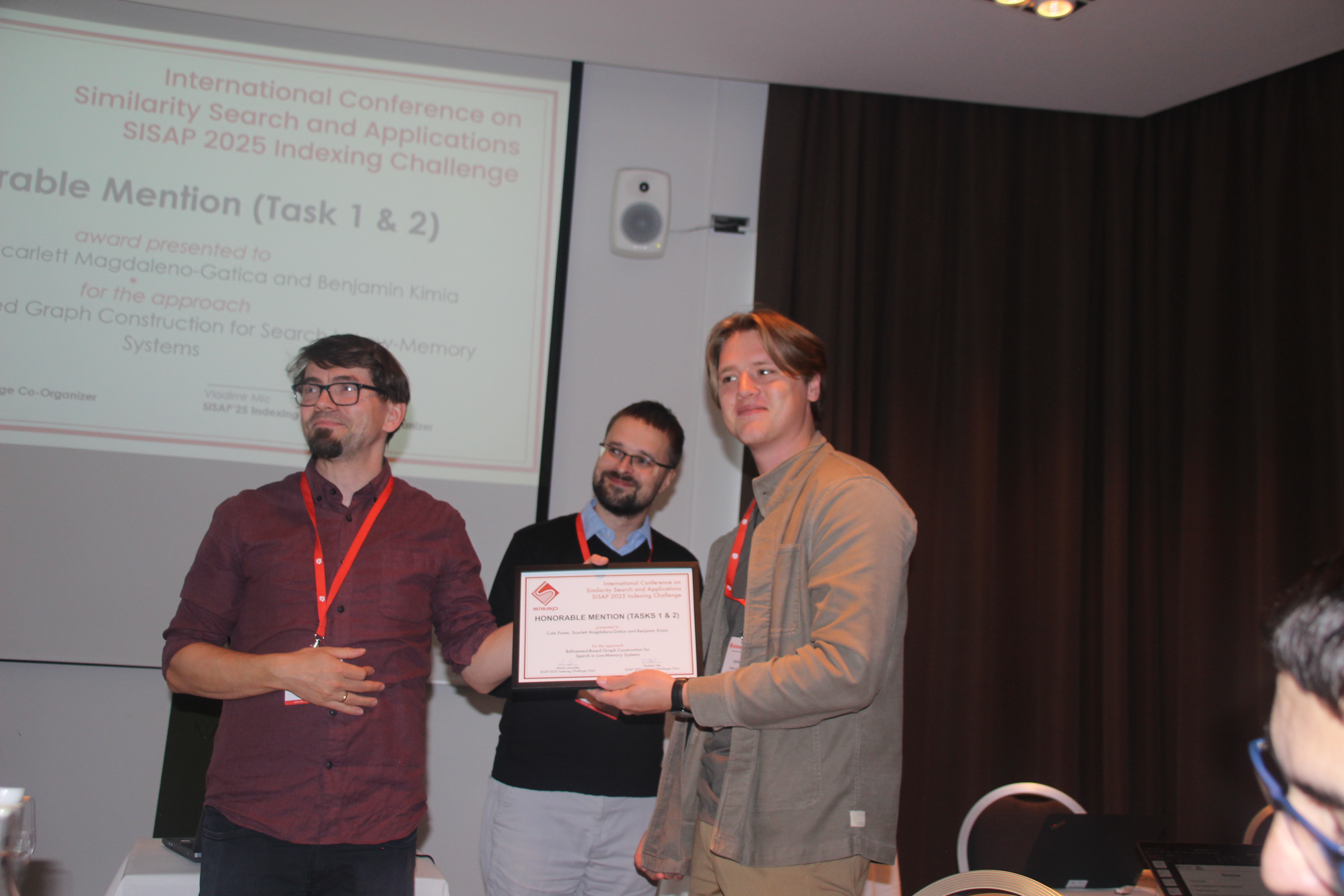
BrownCICESE (Tasks 1 & 2), represented at the conference by Cole Foster, received an honorable mention for their competitive performance across both tasks. Their scalar-quantization approach with HSP-based graph indexing achieved the highest throughput among all participants in Task 1 and placed third in Task 2, demonstrating a versatile and effective solution.
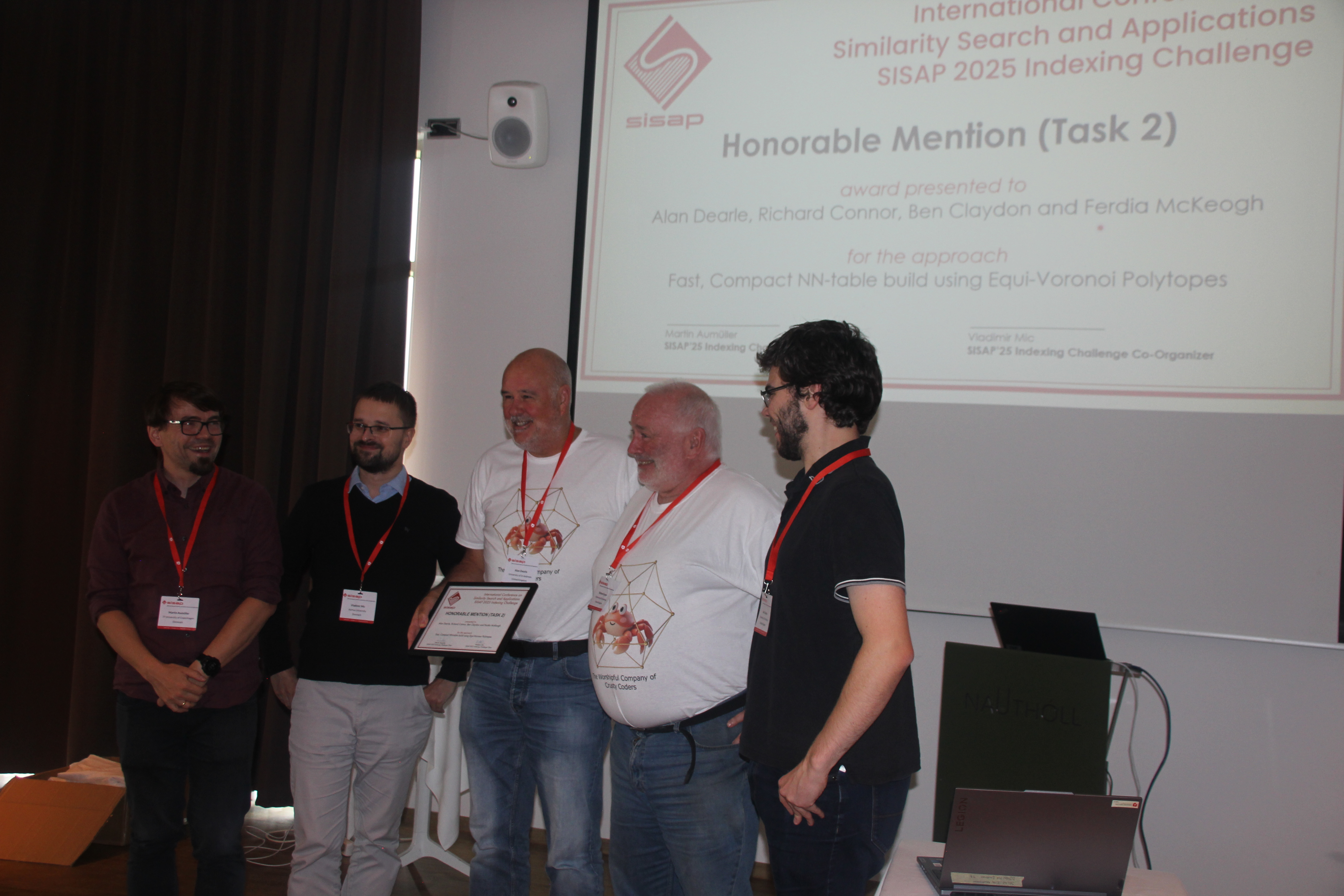
Crusty Coders (Task 2), represented at the conference by Alan Dearle, Richard Connor, and Ben Claydon, received an honorable mention for their novel ultra-quantization technique. Their 2-bit compression scheme with a modified NN-Descent algorithm achieved a compact and efficient -NN graph construction, placing fourth in Task 2 with a total time of 548 seconds while using only 3.1 GB of memory.
For the full technical details, see the Overview of the SISAP 2025 Indexing Challenge by E. S. Tellez, E. Chavez, M. Aumüller, and V. Mic, published in the SISAP 2025 proceedings.